
Rediff.com gives you a look at newbies in the Council of Ministers

'IAF is expanding at a rapid pace'
AMU has once again been pulled into a crossfire of crass political opportunism. In these post-truth times, that the university also had political stirrings not subscribing to the Muslim League is chosen to be forgotten, says Mohammad Sajjad.

'Having a voice at the table means the other side has to show up to listen. It became clear that wouldn't happen,' says actor Maulik Pancholy, one of the 10 members who resigned from the US president's advisory commission on Asian Americans.
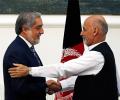
As Ashraf Ghani and Abdullah Abdullah form a joint government after contesting the presidential election against each other, Prakash Bhandari reports from Kabul on the problems facing the new, US-brokered arrangement.

Biometric authentication is based on the unscientific and questionable assumption that there are parts of human body that does not age, wither and decay with the passage of time.

Admittedly, EVMs too have a UID number and any convergence of data can make the secret ballot system a party of history, warns Dr Gopal Krishna in the 5th part of his series against Aadhaar.

'There cannot be any compromise on that. After all, all instrumentalities of the State have been made to serve it. Why was the Constitution made? It was made to serve the cause of India.'

Some 800 million or more Indians gaze at their mobile phones all day. Whoever can crack what's news on the mobile phone for them and their families, for a nominal payment of Rs 10 a month, is a winner, says Ajit Balakrishnan.

India must first improve working condition, then it can concentrate on Make in India concept.

Whether India can create labour-intensive factory jobs instead that it needs to put millions to work in the next few years looks very unlikely.

Though on the face of it appeared Pasbola was asking a series of odd questions that would be difficult for anyone to answer, there was, it gradually emerged, it seemed, a method to the questioning. Somehow, somewhere instinctively, Pasbola knew there was something not right with Riyaz's account.

'...But my strong suit will not be dancing,' Kal Penn tells Vaihayasi Pande Daniel/Rediff.com, in the concluding part of the interview.

'These ISIS terrorists want to smash Western civilisation, smash India. For the time being though, their main target would be the US and Europe.'

Incoming US President Donald Trump has assembled a core team that is -- not surprisingly -- overwhelmingly white and male.

'In the first meeting of this new year, we took a joint new year resolution that we will complete it this year. At the time things were not very clear, but the mood was clear that yes, we must resolve it.' 'Yes, details have to come out, but there are some sensitivities, there are some stake-holders not yet on board, especially other Naga undergrounds etc, we would like them to come on board... So at a proper time it has to be revealed to the country, and to the legislature. Perhaps, we may have to wait for some more time.' 'With better understanding of the Indian system, many of them have learnt, realised, appreciated that Naga nationalist aspirations can be accommodated in the Indian system. The Indian system is pretty comprehensive and flexible.' 'A Naga has as much stake, claim over India as any other Indian. There is no distinction. This, Nagas have realised, that yes, Naga nationalist aspirations and Indian nationalism are not mutually exclusive.' Ravindra Narayan Ravi, the Government of India's Special Interlocutor for the Naga talks, explains how the Naga Peace Accord was reached in an exclusive interview to Saisuresh Sivaswamy/Rediff.com
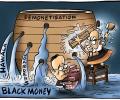
'Modi is likely to make more announcements to win or retain popularity, and put himself at the centre of things even more than now,' says T N Ninan.

Sahara relied on a letter from bank saying the funds were there.

'India was in no position to wage another war in 1965, having suffered a morale-shattering defeat in 1962. The three services were in the middle of a modernisation and expansion phase and therefore not fully trained or battle-ready.'

The National Rifle Association aims to shoot down Vivek Murthy's Senate confirmation as United States Surgeon General, Aziz Haniffa reports

Shyamvar Pinturam Rai and Pradeep Waghmare. Both erstwhile employees of Peter and Indrani Mukerjea. In the witness stand on Monday, Waghmare came across as a cheerful, straightforward man who is attempting to clamber his way towards prosperity. In the witness stand on Friday, Rai shed his customary jauntiness and broke down weeping, begging forgiveness from CBI Special Judge Jayendra Chandrasen Jagdale.

PM Modi addressed a crowded UNESCO gathering, speaking of the importance of culture.
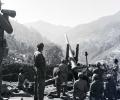
Fifty years ago, India and Pakistan fought a short but bloody war. The author finds out how Sainik Samachar, the defence ministry's journal, reported it.

Pranab Mukherjee's book The Dramatic Decade: The Indira Gandhi Years takes the readers through the economic and social unrest of the period leading up to the emergency, rise and fall of leaders, many splits within the Congress, while promising to offer more in the next two volumes of the trilogy, says Nivedita Mookerji.

This is the joint statement issued by the ministry of external affairs on the visit of US President Barack Obama to India.

Sheela Bhatt meets Bharti Patel, a truly exceptional mother of our times whose son Dr Vikram Patel was recently ranked among Time magazine's 100 most influential people of 2015, to find out her recipe for a remarkable upbringing.

President Pranab Mukherjee on Monday addressed the first joint sitting of Parliament as mandatorily required under the Constitution after the general elections. The address is the political, economic and foreign policy road map of the Narendra Modi government and covers virtually all crucial areas.

'In her insecurity, she destroyed the institutions of democracy,' says Khushwant Singh.

'It is for the first time the voices of the most deferred, the most neglected, the most ignored, the most abused, the most vulnerable - the children-- has been heard. It is a great moment.' 'I always wanted Pakistan and India to have good relationships because I believe that this is very important for the development of both the countries.' 'If children are taught hatred, if they are taught about sectarianism and prejudice, then we can see that there will be terrorism in society." Nobel Peace Prize winners Kailash Satyarthi and Pakistan's Malala Yousafzai were given an ovation after they delivered their rousing speeches in front of a packed audience at a glittering ceremony in Oslo on Wednesday. A day later, they sit down for an interview with CNN's Christiane Amanpour and share their dreams, their hopes for the future. Read excerpts from the interview.
